
Notice: Test mode is enabled. While in test mode no live donations are processed.

$ 0
Select Payment Method
Apoio Healthbot

Blog Post

Compassion

Inside the New Wave of AI Powered Biotech Research Tools

“Speed is not the finish line. The real win is turning faster discovery into fairer access to medicines for the people who need them most.”

Early stage drug discovery has always been a race against time, cost, and complexity. Turning a promising biological insight into testable candidates can take months of coordination between computational teams, wet labs, and limited specialist talent. Now, a new wave of agentic AI research tools is changing that equation by helping scientists design, prioritize, and iterate on drug candidates faster, with lab testing tightly integrated into the workflow.

What makes this shift important is not just speed. When discovery cycles shorten, smaller research teams can run more experiments, explore more disease targets, and reduce the friction that often keeps innovation locked inside a handful of well resourced institutions. For regions working to strengthen biomedical capacity, including Sub Saharan Africa, this kind of tooling can support practical goals like building shared pipelines, improving local research throughput, and accelerating collaboration between universities, startups, hospitals, and funders.


What Amazon Bio Discovery actually does

Amazon Bio Discovery is built around a practical loop that many drug discovery teams aspire to run but struggle to scale: design, test, learn, repeat.

On the product page, Amazon describes a lab in the loop workflow where AI agents help select and orchestrate biological AI models, generate ranked antibody candidates, and send top candidates to integrated lab partners for synthesis and testing. Wet lab results then route back to support analysis and model refinement. [Amazon News]

Key capabilities highlighted by Amazon include:

  • Access to 40 plus AI drug discovery models so teams can experiment without deploying infrastructure
  • No code workflow building that helps computational biologists package reusable pipelines for bench scientists to run at scale
  • Integrated lab partners including Twist Bioscience and Ginkgo Bioworks, with A Alpha Bio listed as coming soon, plus clearer handoffs with pricing and turnaround times
  • Security and data isolation claims aimed at regulated research environments, plus the ability to fine tune models on proprietary experimental data while keeping tuned models private


Amazon also points to early adoption by organizations such as Bayer, the Broad Institute, and Voyager Therapeutics, and notes that 19 of the top 20 global pharmaceutical companies already use AWS for sensitive research workloads. [Reuters]


Proof point: compressing months into weeks

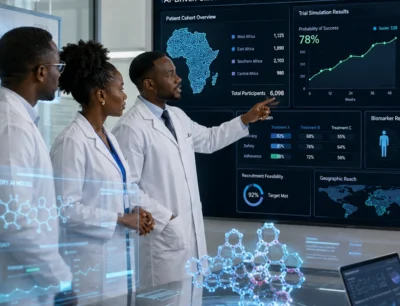
A flagship example cited by Amazon involves a collaboration with Memorial Sloan Kettering Cancer Center. Amazon says the team designed nearly 300,000 novel antibody molecules, narrowed to 100,000 top candidates, and moved to lab testing in weeks rather than up to a year using traditional design approaches.

This is not a guarantee of clinical success, but it is a meaningful operational claim: the tool is targeting cycle time, throughput, and the coordination friction between computational design and wet lab validation.


Why this is bigger than one tool: biology data, agents, and lab automation

Bio Discovery fits into a wider trend: drug discovery advantage is increasingly tied to biology native data infrastructure, agentic workflows, and automated feedback loops. A useful framing comes from Bessemer Venture Partners, which argues that the next wave of biotech leaders will be defined by multimodal datasets, agentic frameworks across R and D, and lab automation that powers rapid experimental iteration.

In parallel, AWS has been publishing patterns for biomedical research agents that connect large model reasoning to specialized tools and databases, which matters because drug discovery is rarely one model call. It is orchestration across literature, omics, assays, and workflows.


What this could mean for the Global South, especially Sub Saharan Africa

The most important question is not whether AI can generate candidates faster. It is whether these gains translate into more relevant medicines, lower costs, and faster access for populations that have historically been underserved by commercial R and D priorities.

Here are concrete pathways where tools like Bio Discovery can help, if paired with the right partnerships:

  • Neglected and poverty related diseases: Faster antibody and biologics design cycles can support work on malaria, TB, and emerging outbreaks, but only if target selection, datasets, and validation reflect local epidemiology and strain diversity.
  • Capacity building for regional research hubs: A no code and agent guided interface can lower barriers for universities and research institutes that lack large computational biology teams, especially when combined with cloud credits and shared pipelines.
  • Stronger translation from discovery to trials: Faster discovery is only valuable if development and trial execution also improve. A related read on trial acceleration and regulatory workflows is here


Practical actions for governments, NGOs, and commercial partners
Government agencies and regulators
  1. Create shared national or regional discovery sandboxes with negotiated cloud access, data governance, and compute credits for public universities and national labs.
  2. Modernize regulatory readiness for AI in medicine development so innovation does not outpace safety and accountability. A helpful background post on global regulatory alignment is here.


NGOs and funders
  1. Fund disease specific model and dataset development that reflects African populations and pathogen diversity, with fair benefit sharing.
  2. Sponsor lab network partnerships so teams can actually close the loop between in silico design and wet lab validation, which is where many Global South projects stall.


Startups, universities, and biotech builders
  1. Start with one high impact pipeline such as antibody developability or binding prediction, then expand to multi objective optimization as local assay capacity grows.
  2. Use partnerships to bridge wet lab gaps while building local capability over time, rather than waiting for perfect infrastructure.


Responsible scale: privacy, IP, and equity

Bio Discovery emphasizes data isolation and customer ownership of proprietary data and IP, which is critical for trust in cross border collaborations.

Still, equitable impact in the Global South requires more than security claims. Programs should define who benefits from discoveries, how local partners share in IP and downstream access, and how datasets avoid bias that could reduce model performance for underrepresented populations.


Conclusion

Faster drug discovery is no longer just a promise on conference stages. With new AI research platforms that connect computational design to real lab testing, teams can move from ideas to validated candidates in a tighter, more practical loop. That shift can lower barriers for smaller labs, reduce dependence on scarce specialists, and increase the number of viable shots on goal for urgent health needs.

But speed alone is not the finish line. The biggest impact will come from how these tools are used: pairing them with high quality, locally relevant datasets, strengthening laboratory capacity, and building partnerships that share benefits fairly. When governments, universities, funders, and biotech builders align around those priorities, AI driven discovery can help deliver more relevant medicines sooner, and make innovation more accessible to the people and regions that need it most.

Similar Posts

AI-Powered Lung Cancer Screening in Public Hospitals: A Scalable Path to Earlier Detection

Telangana is rolling out AI-powered lung cancer screening in public hospitals—using chest X-rays to flag risk early an

Pregnancy Dating Made Easier How AI Ultrasound Supports Faster Clinical Decisions

Butterfly’s FDA cleared AI ultrasound estimates gestational age in under 2 minutes using a simple sweep, making pregna

AI in Biotech: What Today’s Deals Reveal About Tomorrow’s Treatments

AI drug discovery is scaling fast. Here’s what an expanded Insilico Medicine partnership means for faster medicines an

Bottom Image