
Notice: Test mode is enabled. While in test mode no live donations are processed.

$ 0
Select Payment Method
Apoio Healthbot

Blog Post

Compassion

Using AI to Support Nurses and Strengthen Healthcare Access

“Ambient AI for nurses is not about replacing clinical expertise. It is about giving nurses more time, focus, and presence at the patient’s side.”

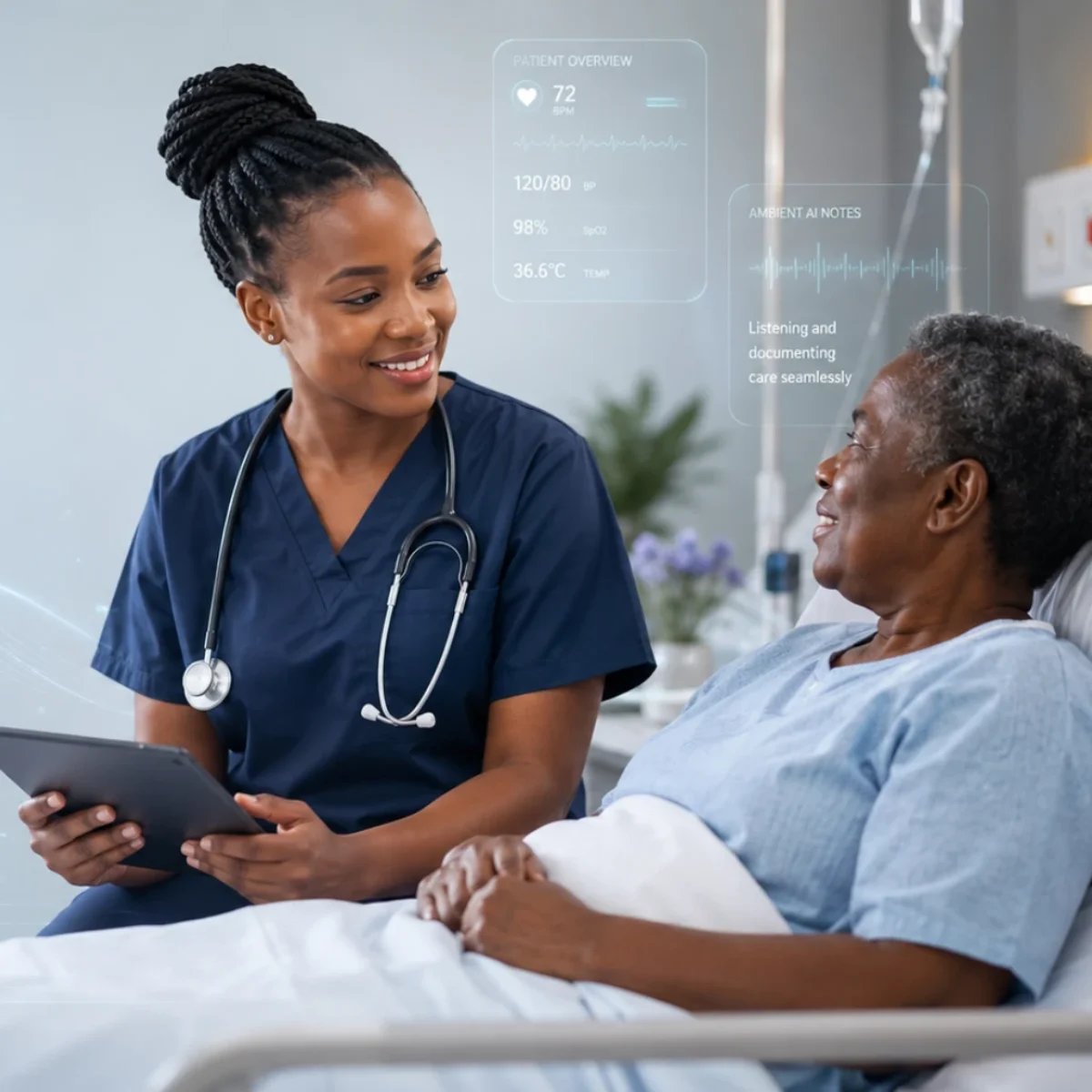
Nurses are at the heart of healthcare delivery, yet they often spend a significant part of their working day documenting care instead of providing it directly at the bedside. This administrative burden affects clinical efficiency, staff wellbeing, and the quality of patient interaction. Abridge’s release of ambient AI technology for nurses marks an important step toward addressing this challenge by using artificial intelligence to capture clinical conversations and generate structured draft documentation for review.

As healthcare systems worldwide face workforce shortages, rising patient demand, and growing pressure to digitize care, ambient AI offers a practical opportunity to reduce routine documentation tasks while preserving clinical oversight. For regions such as Sub-Saharan Africa and the wider Global South, this development also raises important questions about how AI can be adapted to support frontline nurses in resource-limited settings. When responsibly designed and locally validated, tools like ambient AI could help make healthcare more efficient, more accessible, and more human-centered.


A New Milestone for Ambient AI in Nursing

Abridge has announced that its ambient AI technology for nurses is now available to nurses across more than 250 health system clients nationwide, marking an important step in the evolution of AI-powered clinical documentation. According to Healthcare IT News, the tool is designed to automate documentation during patient encounters so nurses can spend less time on screens and more time focused on patients. The solution is already being used by major health systems including Mayo Clinic, Johns Hopkins Medicine, Emory Healthcare, Corewell Health, Bon Secours Mercy Health, Community Health System, and Reid Health. [healthcareitnews]

This matters because nursing documentation is one of the most persistent operational challenges in healthcare. Nurses are expected to record assessments, patient education, medication administration, mobility, wound care, care coordination, and safety observations—often while managing high patient loads. Abridge’s nursing-focused AI aims to move documentation into the background by capturing natural nurse-patient conversations and turning them into structured draft documentation inside the electronic health record, including Epic-integrated workflows described on Abridge’s. [abridge]


Why Nurses Need AI Designed Specifically for Their Workflows

Most early ambient AI tools were designed around physician documentation. Nursing is different. A nurse’s work is continuous, highly interactive, task-rich, and deeply relational. Instead of one discrete consultation, nursing care may involve repeated interactions across a shift: checking symptoms, explaining medications, monitoring vital signs, helping with mobility, supporting family members, and coordinating with other clinicians.

That is why the Mayo Clinic and Abridge collaboration is significant. In Abridge’s own detailed blog, Mayo Clinic nursing leaders explain that nurses were involved in shaping workflows, testing outputs, and refining the tool in real clinical settings. The goal was not simply to adapt a physician scribe product for nurses; it was to design ambient AI around how nurses actually care for patients.

This “built with nurses” approach is essential. AI tools that ignore clinical reality risk adding new work instead of reducing it. But tools co-designed with frontline staff have a better chance of fitting into daily practice. The American Organization for Nursing Leadership has also highlighted Corewell Health’s experience implementing ambient technology with Abridge in its article, which frames documentation simplification as a way to create more space for compassionate care.


How Ambient AI Technology for Nurses Works

At its simplest, ambient AI listens securely during appropriate clinical encounters, identifies relevant clinical information, and generates draft documentation for nurse review. Abridge describes its nursing tool as converting everyday conversations into structured flowsheet entries, with “Linked Sources” that allow users to trace documented rows back to moments in the conversation.

This is important because trust and verification are central to clinical AI. Nurses still need to review, correct, and finalize documentation. The AI does not replace professional judgment; it supports it. A useful ambient system should make it easier for nurses to confirm what happened, identify omissions, and produce a complete record without excessive clicking or delayed charting.

A recent KLAS Research overview, notes that nursing documentation is time-consuming and can detract from direct patient care. The report describes Abridge’s nursing solution as an attempt to document care in real time and examines early customer experience around workflow efficiency, patient engagement, and documentation quality.


What This Could Mean for Patient Care

The biggest promise of ambient AI technology for nurses is not faster paperwork. It is better presence.

When documentation happens after the fact, nurses may worry about forgetting important details. When documentation requires constant screen interaction, the computer can become a barrier between nurse and patient. Ambient AI could reduce that tension by allowing nurses to verbalize assessments and education naturally while the system prepares a draft note in the background.

Abridge’s Mayo Clinic blog describes how conversational care can make patients more engaged because they hear assessments, findings, and care plans explained out loud. This can help patients and families better understand what is happening, ask questions, and feel more confident in the plan.


Why This Matters for the Global South

Although Abridge’s rollout is currently focused on large health systems in the United States, the concept has global relevance. In many African health systems, nurses are the backbone of care delivery. They often serve as the first point of contact, health educator, chronic disease monitor, maternal health supporter, and care coordinator. Documentation burden can be especially challenging in under-resourced facilities where staffing is limited and digital systems may be fragmented.

Ambient AI could eventually support nurses in several high-impact ways: reducing after-hours documentation, improving continuity of care, supporting structured records for referrals, and helping health systems understand patient needs more accurately. However, successful adoption in the Global South would require careful adaptation. Tools must work with local languages, accents, privacy regulations, connectivity constraints, and existing clinical workflows. They must also avoid importing high-cost models that only work in well-funded hospital environments.


The Risks: Privacy, Accuracy, Bias, and Workflow Fit

The release of ambient AI technology for nurses should be welcomed, but not uncritically. Clinical conversations contain sensitive health information. Any system that captures audio or generates documentation must meet strict standards for consent, data security, auditability, and governance.

Accuracy is another major issue. AI-generated drafts may omit details, misinterpret context, or use language that needs clinical correction. A 2026 study on ambient AI draft notes found that clinicians edit AI-generated documentation to shift conversational phrasing toward standardized clinical terminology, highlighting the need for section-aware design and careful clinician review.


Conclusion

Abridge’s release of ambient AI technology for nurses is more than another AI product announcement. It signals a shift toward designing healthcare AI for the people who spend the most time with patients. If implemented responsibly, ambient AI could reduce documentation burden, improve nurse-patient communication, and help health systems capture better clinical information without pulling clinicians away from care.

For the Global South, the lesson is especially important. The future of AI in healthcare will not be defined only by advanced algorithms. It will be defined by whether those algorithms help frontline workers deliver better, more accessible, more human care. Ambient AI for nurses is one promising example of that future—provided it is built with clinicians, validated in real settings, and adapted for the communities it aims to serve.

Similar Posts

Human + AI Teamwork in Radiology: Clinical Trial Shows Better Lung Nodule Calls

DeepFAN AI, tested in a clinical trial, boosts lung nodule malignancy assessment—improving accuracy and consistency fo

Inside the New Wave of AI Powered Biotech Research Tools

Amazon Bio Discovery pairs agentic AI with lab partners to speed early drug discovery and could reshape how faster, fair

AI-Powered Lung Cancer Screening in Public Hospitals: A Scalable Path to Earlier Detection

Telangana is rolling out AI-powered lung cancer screening in public hospitals—using chest X-rays to flag risk early an

Bottom Image