
Notice: Test mode is enabled. While in test mode no live donations are processed.

$ 0
Select Payment Method
Apoio Healthbot

Blog Post

Compassion

Wearable Ultrasound: The Future of Continuous Pregnancy Monitoring

“Wearable ultrasound could move pregnancy care from occasional snapshots to continuous insight, helping clinicians detect risks earlier and support safer births.”

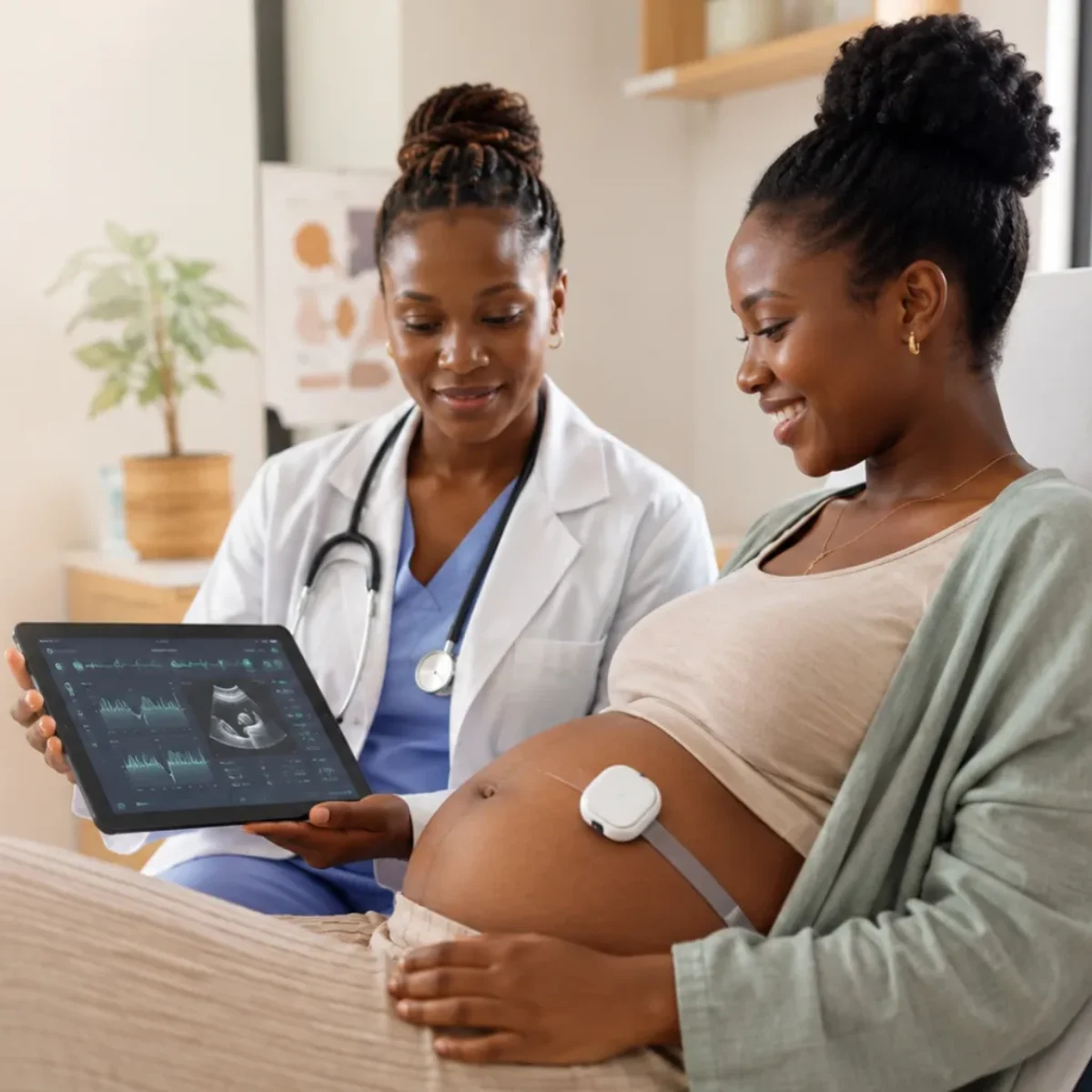
Pregnancy care is entering a new era as scientists develop wearable ultrasound technology capable of continuously monitoring babies in the womb. Unlike traditional ultrasound scans, which offer a brief snapshot during a clinic visit, this innovative wearable patch could track fetal and umbilical cord blood flow over several hours, giving clinicians a clearer picture of a baby’s wellbeing.

This breakthrough has the potential to transform prenatal care, especially for high-risk pregnancies where early detection of complications can make a life-saving difference. By combining wearable sensors, artificial intelligence, and remote monitoring, this technology could help expand access to safer maternity care in underserved communities and support healthcare workers with real-time insights when they matter most.


A New Era for Pregnancy Monitoring

Scientists have developed a wearable ultrasound patch, known as UPatch, that can continuously monitor babies in the womb by tracking fetal and umbilical cord blood flow in real time. The development, reported by The Guardian, is being described as a proof-of-concept breakthrough that could help clinicians detect pregnancy complications earlier and potentially reduce stillbirths. [The Guardian]

Unlike traditional ultrasound scans, which provide only a snapshot during a clinic visit, this wearable ultrasound system is designed to collect ongoing data over several hours. That matters because many fetal health risks are not constant; they can develop, fluctuate, or become visible between scheduled appointments. The original research, published in Nature Biotechnology, explains that UPatch can acquire anatomical structures and blood-flow velocities, while using real-time image segmentation to keep tracking target vessels even during fetal and maternal movement. [Nature]


How the Wearable Ultrasound Patch Works

UPatch is placed on the pregnant person’s abdomen, where it can monitor the fetus and the umbilical cord. According to Stanford Medicine, researchers targeted the placental end of the umbilical cord because it provides a relatively stable point for measuring blood flow, even when the fetus moves. The team also developed an image-segmentation algorithm that helps the patch automatically track the umbilical cord in real time. [Stanford Medicine]

This is a significant engineering achievement. Conventional ultrasound usually depends on a trained sonographer holding and adjusting a probe to find the correct view. UPatch aims to reduce that dependency by making fetal monitoring more autonomous. In early validation, the device was tested in 62 pregnant participants, and its measurements showed statistically equivalent results compared with a standard Doppler ultrasound machine.


Why Continuous Fetal Monitoring Matters

Current fetal monitoring tools can be limited. Hospital-based ultrasound provides valuable information, but it is usually intermittent. Continuous cardiotocography can track fetal heart rate and uterine contractions, but it may generate false alarms and does not provide the same anatomical and blood-flow insight as ultrasound imaging. The Guardian report highlights that the wearable ultrasound approach could fill the gap between occasional scans and less precise continuous monitoring.

This could be particularly important for high-risk pregnancies, including cases involving fetal growth restriction, gestational diabetes, preeclampsia, gestational hypertension, or abnormal fetal growth. In the Nature Biotechnology study, continuous monitoring data from 52 pregnant women aligned with several perinatal conditions, including healthy pregnancies, small-for-gestational-age cases, large-for-gestational-age cases, gestational diabetes, preeclampsia, and gestational hypertension.


The Potential Impact in Low-Resource Settings

The promise of wearable ultrasound is not only technological; it is also about access. In many parts of Sub-Saharan Africa and the wider Global South, pregnant women may live far from facilities with trained sonographers, reliable imaging equipment, or specialist obstetric care. WHO reports that in 2023, approximately 260,000 women died during and following pregnancy and childbirth, with Sub-Saharan Africa accounting for around 70% of global maternal deaths.

Wearable ultrasound will not solve these challenges alone. However, if it becomes safe, affordable, wireless, and easy to use, it could support community health workers, rural clinics, and referral hospitals by helping identify danger signs earlier. UNICEF notes that many maternal and newborn deaths remain preventable or treatable when timely, high-quality care is available.

This is where AI-enabled health systems become essential. A wearable ultrasound patch could collect continuous data, but the real value comes when that data is interpreted, triaged, and connected to care pathways. For example, a rural clinic could use a wearable fetal monitoring device alongside mobile health platforms, telehealth consultations, and AI-supported alerts to decide when a patient needs urgent referral.


Why This Breakthrough Still Needs Careful Validation

Although UPatch is exciting, it remains a proof-of-concept device. It is not yet a routine consumer product, and it should not be treated as a replacement for antenatal care, trained clinicians, or emergency obstetric services. The researchers are working toward further development, including miniaturized electronics and wireless operation.

Safety will also remain central. Stanford Medicine reports that the team assessed acoustic and mechanical energy exposure and said the device met safety thresholds set by bodies including the U.S. Food and Drug Administration, the American Institute of Ultrasound in Medicine, and the British Medical Ultrasound Society.


The Bottom Line

The creation of a wearable ultrasound to continuously monitor babies in the womb could represent a major shift in prenatal care. By moving fetal monitoring from occasional snapshots toward continuous, data-rich observation, UPatch could help clinicians detect complications earlier, support high-risk pregnancies more effectively, and expand diagnostic reach in underserved communities.

The most powerful future will not be the device alone. It will be the combination of wearable sensors, AI interpretation, telehealth, trained health workers, and strong referral systems. Used responsibly, this kind of innovation could help make pregnancy care safer, more proactive, and more equitable for families everywhere.

Similar Posts

The Future of AI Health Coaching Is Already on Your Wrist

Fitbit is becoming Google Health, marking a major shift toward AI-powered coaching, wearable insights and preventive dig

Using AI to Support Nurses and Strengthen Healthcare Access

Abridge’s ambient AI helps nurses reduce documentation time and focus more on patient care.

Human + AI Teamwork in Radiology: Clinical Trial Shows Better Lung Nodule Calls

DeepFAN AI, tested in a clinical trial, boosts lung nodule malignancy assessment—improving accuracy and consistency fo

Bottom Image