
Notice: Test mode is enabled. While in test mode no live donations are processed.

$ 0
Select Payment Method
Apoio Healthbot

Blog Post

Compassion

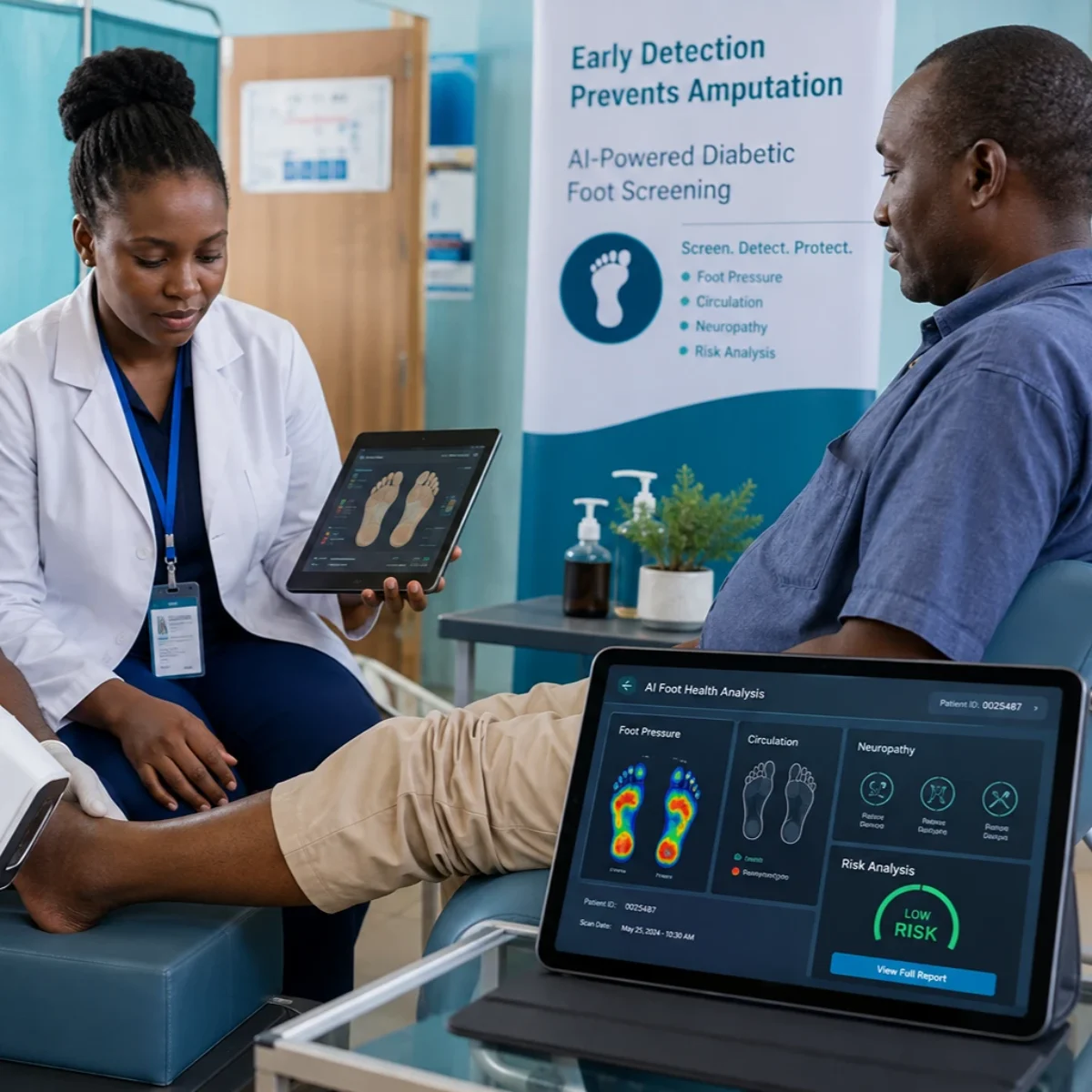
AI Is Bringing Earlier Diabetic Foot Detection Closer to Patients

“The real promise of healthcare AI is not just smarter algorithms—it is helping clinicians detect risks earlier and bring better care closer to patients.”

A new investment in Indian medical technology highlights an increasingly important direction for artificial intelligence in healthcare: using AI and portable diagnostics to identify preventable complications before patients require expensive specialist treatment.

Bengaluru-based [Ayati Devices] has raised INR 15 crore in Pre-Series A funding led by Inflexor Ventures, marking the company’s first institutional investment. The funding is expected to help Ayati commercialise its diagnostic technologies, increase manufacturing capacity, strengthen research and development, pursue additional regulatory approvals and expand internationally.

For healthcare systems across emerging markets—including countries in Sub-Saharan Africa—the significance extends beyond a single funding round. Ayati demonstrates how AI-driven diabetic foot diagnostics, portable medical devices and alternative financing models could help move chronic disease management away from late-stage intervention and towards earlier, decentralised prevention.


Why diabetic foot diagnostics matter

Diabetes can cause peripheral neuropathy, reducing a person’s ability to feel pain or injury in the feet. Vascular complications can simultaneously impair circulation and healing. A seemingly minor injury can therefore progress without being noticed, potentially developing into an ulcer, infection or, in severe cases, amputation.

The challenge is particularly important because detecting risk early requires more than simply waiting for a visible wound.

According to the [Express Healthcare report on Ayati’s funding round] more than 90 million people in India live with diabetes, while the country experiences more than 50,000 lower-limb amputations annually. The report notes that many of these amputations could be prevented through timely diagnosis.

This makes diabetic foot care an ideal example of where technology can create value before a medical emergency occurs.

Research is increasingly supporting this direction. A 2026 study available through [PubMed on AI-enhanced diabetic foot imaging] examined an AI method for segmenting diabetic foot ulcers and classifying their severity. The researchers worked with 1,339 ulcer images from 510 patients and also developed an AI-powered mobile application intended to support real-time and remote assessment.


What Ayati Devices is building

Ayati’s approach is particularly interesting because it is not centred on one standalone AI application.

The company’s [Ayati Foot Labs platform] brings technologies for neuropathy, vascular status, microcirculation and plantar-pressure assessment into a broader foot-health ecosystem designed for hospitals, clinics and screening programmes. The goal is to help clinicians identify risk earlier and follow patients more effectively.

Its portfolio includes several technologies covering different stages of diabetic foot assessment.

Vibrasense provides objective neuropathy screening, while Vibrasense+T extends assessment across nerve functions. Vasosense is designed to detect peripheral artery disease without requiring a specialist. Angiocam provides portable, real-time tissue-perfusion imaging. Ayati also offers the PODIA Trolley, a screening station available through a pay-per-test model rather than requiring healthcare providers to make a large upfront capital investment.

That combination is important.

AI healthcare is sometimes discussed as though software alone will transform clinical outcomes. In reality, healthcare access often depends on a complete delivery system: sensors, devices, software, clinical workflows, trained health workers, referral pathways, financing and follow-up.

Ayati is addressing several of those layers simultaneously.


INR 15 crore is funding commercial scale—not simply experimentation

The funding round represents a transition from developing and validating technology towards broader commercial deployment.

Ayati says the investment will support the commercialisation of Angiocam, domestic and international go-to-market expansion, manufacturing and supply-chain capacity, AI-enabled diagnostic R&D, regulatory approvals, intellectual property development and recruitment across engineering, clinical, regulatory and business-development functions.

The company already has more than 10,000 devices deployed across over 30 countries, according to the funding announcement. Its technologies have obtained regulatory clearances in several markets, including India, the United States and Europe, as well as approvals in markets including Sri Lanka, Malaysia and the UAE.

That existing footprint makes the investment noteworthy. The capital is being directed at scaling technologies that have already moved beyond an early laboratory concept.


Why AI can change diabetic foot screening

One of AI’s strongest potential contributions to healthcare is not replacing clinicians. It is helping health systems make specialist knowledge and objective assessment available at more points of care.

Diabetic foot assessment traditionally depends heavily on clinical expertise, physical examinations and specialist diagnostic equipment. In settings where specialists are concentrated in major cities, patients in rural or underserved communities may reach advanced care only after complications have progressed.

AI-assisted and digitally connected diagnostics can potentially change that model.

A comprehensive 2025 review available through [PubMed on AI and generative AI for diabetic foot ulcer care] examined applications including classification, prediction, segmentation and detection. These are precisely the kinds of capabilities that could eventually help clinicians recognise high-risk cases earlier and prioritise patients requiring specialist attention.


The pay-per-test model could be as important as the AI

Ayati’s PODIA Trolley deserves particular attention from an access perspective because it uses a pay-per-test screening model with zero upfront capital investment, according to the company announcement.

Medical equipment can be clinically valuable and still fail to reach patients because smaller facilities cannot afford the purchase price.

A usage-based model potentially changes that calculation. Instead of requiring a clinic to purchase expensive equipment before screening its first patient, costs can be tied more closely to actual utilisation.

For resource-constrained healthcare systems, this could provide a useful blueprint: innovation should focus not only on making devices cheaper, but also on making the economics of accessing those devices more flexible.


What this could mean for Africa and other underserved markets

Ayati’s announced international expansion currently focuses on Europe, the United States, the Middle East, Southeast Asia, Australia and Latin America. Africa was not listed among those immediate expansion regions, so it would be premature to suggest that an African rollout has been announced.

Nevertheless, the model has strong relevance for African healthcare innovation.

Diabetes and other non-communicable diseases increasingly require health systems to manage patients over many years rather than only respond to acute illness. Yet specialist availability, diagnostic infrastructure and continuity of care remain uneven across many regions.

Portable technologies capable of supporting screening at primary-care facilities, pharmacies, mobile clinics or community health programmes could help bring sophisticated diagnostics closer to patients.


The bigger lesson: AI healthcare must reach the point of care

The most important aspect of the Ayati Devices investment may ultimately be the problem it is trying to solve.

AI healthcare delivers limited value if advanced diagnostics remain available only inside major specialist hospitals. Its transformational potential appears when reliable technologies can move closer to the patient—into primary-care centres, community programmes and other frontline settings—while helping clinicians recognise risks early enough to intervene.

Ayati’s funding also demonstrates that building such systems requires more than training an algorithm. Companies need manufacturing capacity, regulatory approvals, clinical evidence, distribution networks, workable payment models and technologies designed around real clinical workflows.

Those considerations are especially important for emerging markets.

The next generation of healthcare innovation will therefore be measured not simply by algorithmic accuracy, but by accessibility, affordability, clinical usefulness and scalability.

Ayati Devices’ INR 15 crore funding round is a relatively modest investment compared with the enormous sums flowing into generative AI, but its potential impact illustrates another side of the AI revolution: practical technology designed to prevent avoidable disability before it becomes irreversible.

Similar Posts

AI-Powered Clinical Trial Simulations Gain $45M Boost

QuantHealth raises $45M to expand AI-powered clinical trial simulations, supporting faster drug development and more inc


Operational AI Governance: A New Priority for Health Systems

DiMe is developing practical AI governance tools to help healthcare organisations adopt, monitor and manage artificial i

A New Era for Responsible AI Regulation in European Healthcare

Portugal becomes the first EU state to join HealthAI, advancing safer, more transparent and globally coordinated AI regu

Bottom Image
