
Notice: Test mode is enabled. While in test mode no live donations are processed.

$ 0
Select Payment Method
Apoio Healthbot

Blog Post

Compassion

Human + AI Teamwork in Radiology: Clinical Trial Shows Better Lung Nodule Calls

“When AI strengthens imaging decisions, it can reduce uncertainty, standardize quality, and help teams act faster on high-risk nodules.”

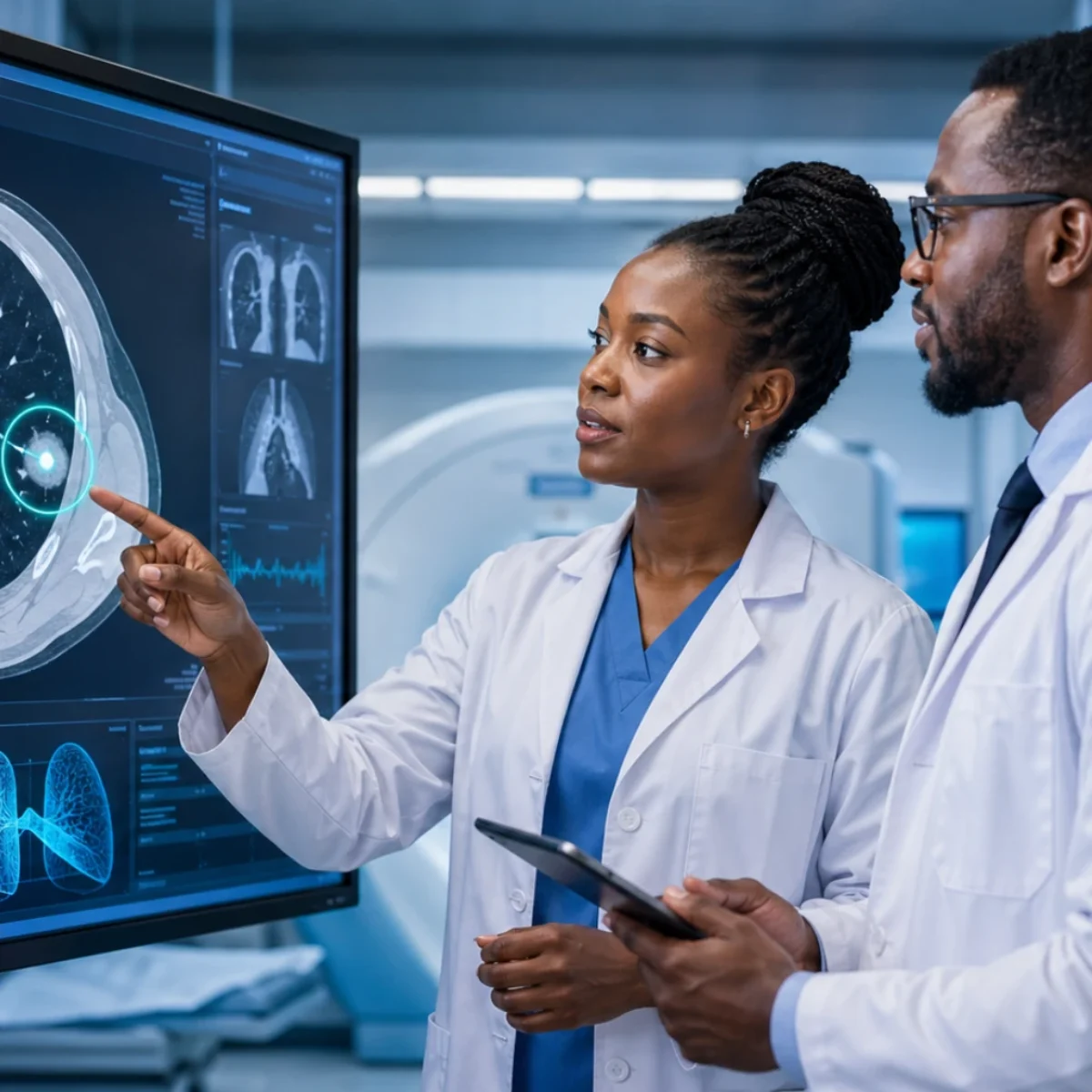
Lung nodules are common findings on chest CT scans, and they create a familiar dilemma for clinicians everywhere: which nodules are likely malignant and need urgent workup, and which are benign and can avoid costly, anxiety inducing follow up. A new research briefing in Nature Cancer, highlights a clinically validated breakthrough: an artificial intelligence model called DeepFAN that improved lung nodule diagnostic accuracy in a multi center clinical trial, especially when used to assist junior radiologists. [Nature]

This matters because radiology capacity is uneven globally, CT volumes are rising, and pulmonary nodule pathways often struggle with two risks at once: missed cancers and unnecessary repeat imaging. If AI can safely reduce diagnostic uncertainty and standardize quality across readers, it becomes more than a clever algorithm. It becomes health system infrastructure.


What the DeepFAN clinical trial actually showed

DeepFAN is a transformer based model trained on more than 10,000 pathology confirmed nodules. The team then tested the model in a multi reader, multi case clinical trial registered in the Chinese Clinical Trial Registry under ChiCTR2400084624, using 400 cases across three independent medical institutions.

DeepFAN performed strongly on its own, reaching an area under the curve, often shortened to AUC, of 0.939 on an internal test set and 0.954 on the clinical trial dataset. But the headline result is what happened when humans used it as an assistant: across 12 readers, average performance improved materially, including AUC up by 10.9 percent, accuracy up by 10.0 percent, sensitivity up by 7.6 percent, and specificity up by 12.6 percent, with statistically significant gains across metrics. Interreader diagnostic consistency also improved, moving from fair to moderate agreement, with the kappa score rising from 0.313 to 0.421.

That combination is important. Health systems do not just need higher accuracy in ideal conditions. They need repeatable, consistent decisions across many facilities and clinicians, including less experienced readers working under time pressure.


Why this kind of evidence is a step forward for real world adoption

Many imaging AI models report retrospective performance, often on narrow datasets. DeepFAN is notable because it was assessed in a clinical trial setting designed to test human plus AI collaboration, not just standalone prediction.

It also includes practical signals about implementation readiness. The authors describe a web based AI platform and make code available on GitHub, while referencing the National Lung Screening Trial dataset hosted by The Cancer Imaging Archive..

For health leaders, this helps answer a question that matters more than leaderboard performance: can this tool improve clinical teams today, in workflows that resemble day to day radiology practice.


What this unlocks for emerging market lung cancer detection strategies

Across the Global South, CT access is expanding but specialist interpretation and structured nodule follow up often lag. The DeepFAN trial suggests three practical pathways to impact:

First, quality equalization. If junior radiologists become more accurate and consistent with AI assistance, health systems can reduce the gap between tertiary centers and provincial hospitals, without waiting a decade to train enough subspecialists.

Second, fewer unnecessary follow ups. The Nature Cancer authors explicitly frame DeepFAN as a tool that could reduce unnecessary follow up of indeterminate nodules, which is where costs and patient distress often accumulate.

Third, better use of scarce specialist time. AI can triage low risk cases and surface high risk nodules for senior review, creating a workflow where specialists focus on the hardest decisions.


A deployment blueprint for ministries, hospitals, NGOs, and implementers

Evidence is necessary, but scale requires execution. A practical deployment plan usually includes:

  1. Define the pathway, not just the model. Decide who gets scanned, what thresholds trigger referral, and how confirmation testing is guaranteed. AI without a referral pathway can increase anxiety and churn.
  2. Validate locally and monitor drift. DeepFAN’s strength is multi center testing, but every deployment still needs local auditing across scanner types, protocols, and disease mix.
  3. Invest in workforce enablement. DeepFAN improved junior reader performance precisely because it was used as an assistant. Training should focus on how to interpret AI outputs, when to override them, and how to communicate uncertainty to patients.
  4. Pair detection with follow up systems. Nodule care is a longitudinal process. For a strong operational view of closed loop follow up technologies, this Qure.ai explainer is worth reading.


Conclusion

AI assisted lung nodule assessment is moving from promising research into clinically validated practice. The DeepFAN trial shows that a transformer based model can materially improve diagnostic accuracy, boost sensitivity and specificity, and increase consistency across readers, with the biggest gains seen among junior radiologists. That combination points to a practical route for health systems seeking earlier lung cancer detection while reducing unnecessary follow up scans and avoidable patient anxiety. The next step is thoughtful deployment: local validation, clear referral pathways, clinician training, and ongoing monitoring so the technology strengthens real workflows and delivers measurable outcomes for patients and providers.

Similar Posts

Inside the New Wave of AI Powered Biotech Research Tools

Amazon Bio Discovery pairs agentic AI with lab partners to speed early drug discovery and could reshape how faster, fair

AI-Powered Lung Cancer Screening in Public Hospitals: A Scalable Path to Earlier Detection

Telangana is rolling out AI-powered lung cancer screening in public hospitals—using chest X-rays to flag risk early an

Pregnancy Dating Made Easier How AI Ultrasound Supports Faster Clinical Decisions

Butterfly’s FDA cleared AI ultrasound estimates gestational age in under 2 minutes using a simple sweep, making pregna

Bottom Image