
Notice: Test mode is enabled. While in test mode no live donations are processed.

$ 0
Select Payment Method
Apoio Healthbot

Blog Post

Compassion

Beyond Innovation: How to Deploy AI Breast Screening Tools Responsibly

“Technology only changes outcomes when it is validated, trusted, and connected to real pathways of care.”

Breast cancer outcomes are shaped less by medical breakthroughs and more by whether women can access early detection and timely diagnosis. That is why the news that Lord’s Mark Industries Limited has signed a technology transfer agreement with CMET, the Centre for Materials for Electronics Technology, to manufacture an AI powered, radiation free breast screening wearable device is worth watching closely. [The Economic Times]

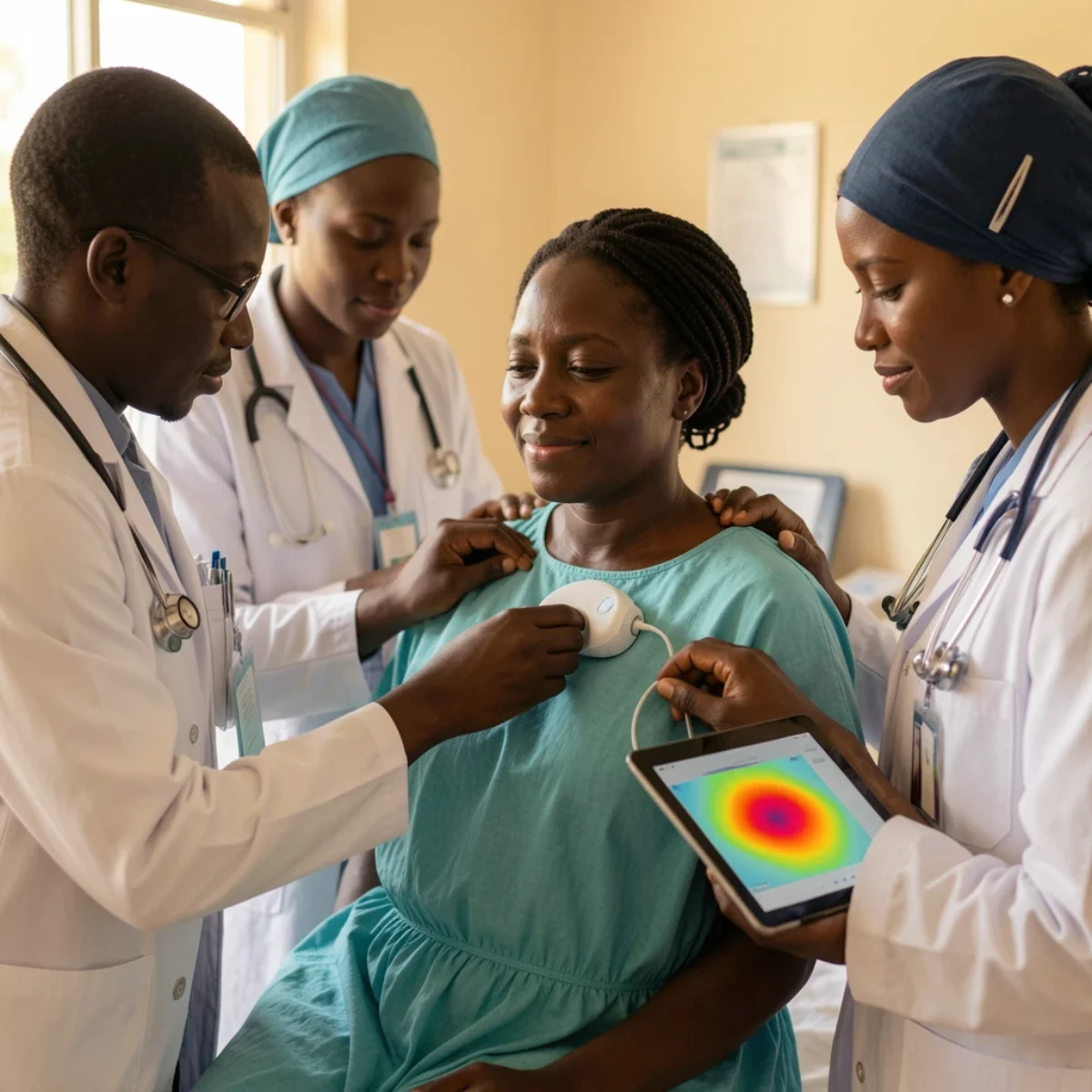
The announcement positions the device as portable, infrastructure light, and designed to support early abnormality detection using high precision thermal sensors and AI driven temperature mapping. If this collaboration translates into rigorous clinical validation and thoughtful deployment, it could add a practical new option to the breast screening toolbox for countries where mammography coverage is limited, including many health systems across Sub Saharan Africa.


What exactly was announced and what is the device trying to do

According to reporting, Lord’s Mark will combine its manufacturing scale and distribution capacity with CMET research and development capabilities to commercialize a wearable screening device intended for large scale breast cancer screening. The described advantages include non radiative and painless use, minimal setup in clinics or community settings, privacy first wearability under clothing, and mobility that could support outreach beyond hospitals.

CMET is a Government of India research and development institute under the Ministry of Electronics and Information Technology, with labs in Pune, Hyderabad, and Thrissur, and a mandate that includes technology transfer. That matters because technology transfer is often where promising prototypes either become scalable products or stall. A structured transfer agreement can accelerate manufacturing readiness, quality systems, and pathways to regulatory review.


Why this matters for the Global South and especially Sub Saharan Africa

The public health case is clear. The World Health Organization estimates breast cancer caused about 670,000 deaths globally in 2022 and remains the most common cancer in women in most countries. In Sub Saharan Africa, late stage diagnosis is a persistent challenge, with published reviews reporting that a large share of patients present at advanced stages, often tied to low awareness, limited diagnostic services, and constrained referral pathways.

This is exactly the gap that point of care screening tools try to address: make the first step easier, cheaper, and closer to where people live, so that more women enter the diagnostic pathway early enough for treatment to be effective.

WHO’s Global Breast Cancer Initiative emphasizes three system priorities: health promotion and early detection, timely diagnosis, and comprehensive management. A wearable screening approach can only help if it strengthens those full pathways, rather than creating screening without follow up. That is why implementation design matters as much as the device itself.


The promise and the caution with thermal sensing plus AI

Thermal sensing and thermography approaches aim to detect abnormal heat patterns linked to changes in blood flow and metabolism, and AI can help turn complex thermal maps into consistent risk signals at scale.

At the same time, health authorities have repeatedly warned that thermography should not be used as a substitute for mammography as a primary screening method, and that marketing it as a replacement can create dangerous delays in diagnosis. This is not a reason to dismiss innovation. It is a reason to demand strong evidence, clear intended use, and transparent performance reporting before deployment.

A responsible target use case for a wearable thermal plus AI device in low resource settings is often triage and referral support: identifying who should be prioritized for confirmatory imaging and diagnostic workup, especially where mammography capacity is scarce.


What governments, NGOs, and commercial partners can do to turn innovation into access

If you work in a health ministry, donor program, or implementing NGO, the most important question is not whether the device is exciting. It is whether it improves real outcomes: earlier stage at diagnosis, faster diagnostic turnaround, and higher completion of referral and treatment.

Practical actions that fit Global South realities:

  • Government agencies: Embed evaluation into national cancer control plans, define where the tool sits in guidelines, and procure only with performance and safety evidence that matches local needs. WHO guidance on strengthening breast cancer systems can help frame that pathway.

  • NGOs and implementers: Fund supervised pilots that include navigation support, transport vouchers, and clear referral agreements with diagnostic centers. Patient navigation can reduce time to diagnosis and improve adherence, especially when systems are fragmented.

  • Commercial entities: Build for field conditions, offline first workflows, multilingual interfaces, and end to end quality management. The product is not only the sensor. It is training, maintenance, data governance, and clinical escalation.


Research and funding priorities that will determine whether this scales responsibly

To be credible and scalable across Africa and other low and middle income regions, the next phase should prioritize:

  • Independent clinical validation across diverse populations and settings, not only controlled environments

  • Bias and subgroup analysis so performance does not degrade for specific age groups, breast density patterns, or comorbidities

  • Implementation science to measure referral completion, time to diagnosis, and stage shift outcomes

  • Regulatory readiness aligned with emerging expectations for AI quality and lifecycle monitoring


Where this sits in the broader AI breast cancer landscape

It is useful to place this wearable approach alongside the strongest current evidence base, which is largely in AI assisted interpretation of mammograms and other imaging modalities.

For example, Google has published ongoing work on AI and breast cancer screening in real world settings, including how AI can support radiologists and reduce workload. Microsoft’s AI for Good Lab has also described partnerships focused on improving accuracy and trust in breast screening AI. The Breast Cancer Research Foundation has a practical overview of where AI is helping and what challenges remain for deployment. And PATH has long emphasized that survivorship gains in low resource settings depend on strengthening the full chain from awareness to diagnosis to treatment.

The takeaway is simple: an AI based wearable can be powerful, but it will be judged by evidence, integration, and equity, not by novelty.


Conclusion

Lord’s Mark’s collaboration with CMET to develop an AI based breast cancer detection device is an example of how commercial manufacturing capacity and public sector research can work together to tackle a high burden problem. For Sub Saharan Africa, the opportunity is real if deployment is paired with validation, referral pathways, and patient support.

If your organization is building cancer screening programs, designing pilots, or funding digital health innovation, this is a moment to ask the right questions early: What is the intended use, what evidence exists, what happens after a positive screen, and how will we measure true stage shift and survival impact.

Similar Posts

Wearable Tech and AI in Healthcare: Building Trustworthy Evidence at Scale

Verily and Samsung are bringing Galaxy Watch data into clinical trials, enabling remote monitoring, real world evidence,

The Growing Role of AI Assistants in Healthcare Access

Amazon’s new healthcare AI assistant could reshape how people access health information, navigate care, and engage wit

AI Agents in Healthcare: Streamlining Notes, Claims, and Operations at Scale

Oracle Health is embedding AI into everyday workflows to cut admin burden, speed reimbursements, and give clinicians mor

Bottom Image